Choosing a garden tree for shade begins with the place you want to shade, not with a tree at the nursery. A tree can become one of the most valuable parts of a new garden in Southern Israel. However, the wrong location can crowd a patio, block a route, compete with planting or create maintenance problems near walls and paving.
The best position gives the household useful shade when it is needed. At the same time, it leaves enough room for the tree and garden to develop. Before choosing a species, assess sun, daily use, mature size, available soil and irrigation. This process makes the eventual choice more likely to suit your home.
Start by defining what the tree needs to do
A tree may provide shade, but it can also have other jobs. For example, it might frame an indoor view, soften a boundary or create a focal point at the end of a path. It may also add height to a planting bed. These roles can point to different locations.
For example, a tree that shades an outdoor dining table needs a different position from one that structures the back of a long garden. Likewise, a tree for screening may need to work with a fence and layered planting. In contrast, a specimen tree needs visual space around it to make an impact.
Write down the main purpose before you look at options. Then list any secondary benefits you would like. This simple step prevents a tree from becoming an attractive purchase without a clear role in the layout.
- Shade: comfort over a seating area, play space or part of the patio.
- Structure: a taller, lasting element that anchors a new garden.
- Screening: a softer layer between the garden and a boundary or neighbouring view.
- Framing: a feature that guides the eye towards, or away from, a particular view.
Map the shade before choosing a garden tree for shade
In a sunny Southern Israel garden, shade that falls in the wrong place has limited value. First, identify where people actually spend time outdoors. Consider breakfast seating, afternoon play, evening dining and the route between the house and garden.
Next, observe the garden at several times of day. Take photographs from the same points. Then note where direct sun lands on the patio, lawn and planting beds. Shade position and length change throughout the day. Therefore, one quick observation is not enough.
A tree offers living shade that develops gradually. Therefore, it may complement a pergola rather than replace one. If you need reliable coverage over a dining area now, a fixed shade solution may be more appropriate. A tree can then soften the edges of that outdoor room and improve comfort around it over time.
For a wider approach to sun direction, structures and planting, read our guide to planning shade for a south-facing garden in Southern Israel.
Allow for mature form, not nursery size
New garden trees often look small beside a house, fence or patio. As a result, homeowners may place them too close together or too near another feature. Instead, base spacing decisions on the expected mature canopy, trunk and root area.
Mature form matters as much as height. Some trees develop a broad canopy, while others grow in a more upright shape. Similarly, some keep dense foliage, while others cast lighter, shifting shade. The right form depends on the available space and the shade you want.
Ask a knowledgeable local nursery or landscaping professional for plant-specific information. In particular, confirm the expected mature dimensions and growth habit of the proposed tree. A local assessment matters because conditions, establishment care and the plant itself affect its development.
Leave enough room for the canopy. Do not assume hard pruning will solve a poor location. Repeatedly cutting a tree back to fit an unsuitable gap can weaken the design intention. It can also create an ongoing task.
Picture the garden several years ahead
Stand where the trunk might go and imagine the tree at its mature scale. Then check whether its canopy could extend over a seating area, lawn, path, planter or neighbouring bed. Also consider how it will look from key windows and doors.
In a compact Carmei Gat garden, one well-positioned tree may offer more value than several trees competing for a small area. Meanwhile, a larger garden in Kiryat Gat or Even Shmuel may suit a tree within a layered planting composition. The principle remains the same: give each tree a defined purpose and enough space to fulfil it.
Check clearances around walls, paving and garden features
Good garden tree placement considers planned features. These include the house, boundary walls, paving, decking, pergolas, pools, play areas, drainage points and service access. Therefore, do not select a position simply because it is an empty patch of soil.
Leave practical circulation space around paths, gates and seating. Otherwise, an expanding canopy can turn a comfortable route into a narrow passage. Likewise, do not position a future trunk where it will make ordinary garden care difficult.
Tree roots and growth behaviour vary significantly by species and site. For that reason, do not rely on broad rules or assumptions about a “safe” distance from a wall, pipe or paved surface. Instead, discuss the species and location with a qualified local professional. This is especially important near built structures, underground services or existing mature planting.
Also consider maintenance access. Can someone reach the surrounding bed, clean beneath the canopy and inspect irrigation without disturbing the tree or its neighbours? A clear layout makes future care easier.
Assess soil volume, ground conditions and drainage
A tree needs more than a planting hole. It needs a realistic volume of soil for establishment and growth. Narrow strips between paving and a wall may look available. However, they may not offer enough useful root space for the intended tree.
Start by observing the ground after rain and irrigation. Does water sit in one area? Does the soil seem heavily compacted after construction? Are there level changes, retained areas or hard surfaces that limit the planting bed? These observations should shape the planting plan before work begins.
New-build gardens can contain disturbed or compacted ground. However, each property differs. A site assessment can identify where a generous planting bed is feasible. It can also show where the ground needs more consideration before tree installation.
Do not use a tree to disguise a drainage issue. First, establish how water moves through the garden and away from hard surfaces. The tree location can then support a sensible layout rather than create another constraint.
Coordinate the tree with beds, lawn and irrigation
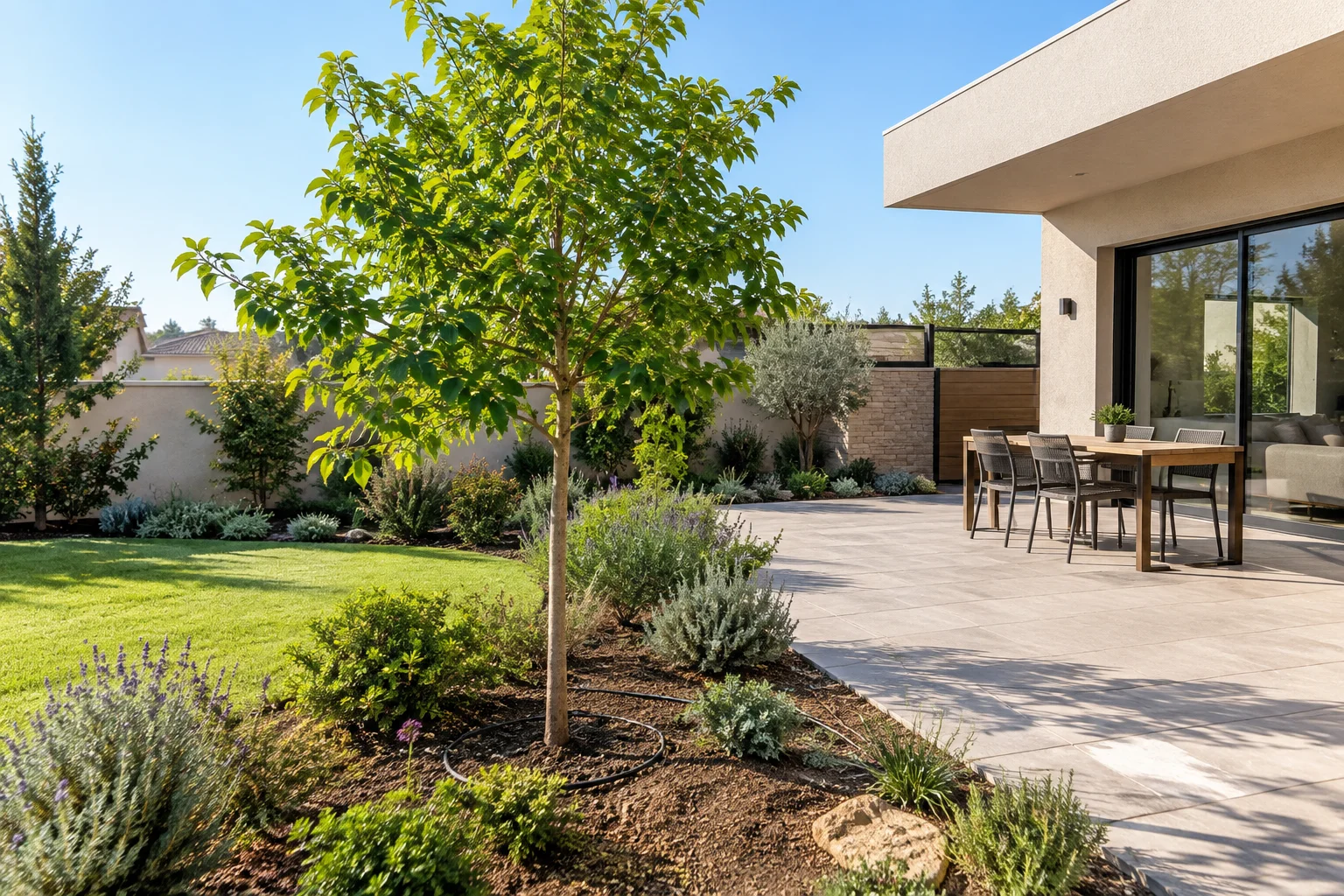
Choosing a garden tree for shade works best when the tree forms part of the whole garden plan. The surrounding bed should allow room for the tree. In addition, it should protect the soil from unnecessary compaction and give the base a deliberate finish.
Think about what will sit below and around the canopy. A tree near a lawn may suit an open family garden. On the other hand, a planted bed can create a more layered, lower-water composition. It can also reduce awkward mowing around the trunk. Neither approach is automatically better. Instead, base the choice on garden use and maintenance expectations.
New garden trees also need establishment care. Therefore, their location should fit an irrigation plan that separates areas with different water needs where appropriate. Trees, lawn, planting beds and planters do not always belong on the same watering schedule. Our guide to planning garden irrigation zones explains why the layout should come before final irrigation decisions.
When selecting nearby shrubs and ground cover, consider their mature size too. Dense planting around a young tree can look full immediately. However, it may leave little room as the garden matures. A clear planting plan balances early impact with future space.
A practical shade tree planning checklist
When choosing a garden tree for shade, use this checklist to test the proposed location. It will also make a design or nursery conversation more productive.
- State the tree’s main job: shade, structure, screening or framing a view.
- Record where sun falls when the household uses the garden most.
- Mark patios, paths, walls, garden furniture, play areas and planned structures.
- Check the available planting-bed width and soil volume.
- Consider mature canopy shape and scale, not the current nursery size.
- Identify access needs and nearby services or built features that require professional review.
- Include the tree within the wider planting and irrigation layout.
- Ask for a local, plant-specific suitability assessment before making the final selection.
When professional assessment is worthwhile
Professional input is especially useful when the tree will sit near a house, patio, boundary, deck, pergola or existing irrigation. It is also valuable when a new garden has limited space, uneven ground, drainage concerns or competing priorities.
A thoughtful plan can test the position alongside paving, planting beds, synthetic grass, shade structures and outdoor carpentry before installation starts. As a result, the tree supports the garden instead of becoming an obstacle to future improvements.
Creative Garden Co. helps homeowners plan and build new gardens and renovations across Southern Israel. For broader planting principles, explore our practical guide to low-water planting. Alternatively, see how our Southern Israel landscaping services bring planting, shade, irrigation and outdoor living areas into one coordinated garden plan.
A well-sited tree takes time to become the shade feature you imagined. Therefore, taking time to assess the site before buying is one of the best decisions you can make for a comfortable, balanced garden.
For help with your garden project, also see our Garden Design & Installation.