Garden drainage is worth investigating before you renovate, even when the visible puddle seems small. Water may be arriving from a hard surface, collecting at a low point, or being held back by a change in level. Recording what happens during rain gives you and your garden professional a much clearer starting point than choosing a new surface first.
In Southern Israel, long dry periods can make it easy to overlook drainage until a wet spell arrives. However, rainwater near a patio, house threshold, path or boundary wall deserves attention. The aim is not to guess the solution from one puddle. Instead, identify where the water comes from, where it stops, and which parts of the garden it affects.
Assess garden drainage before renovating
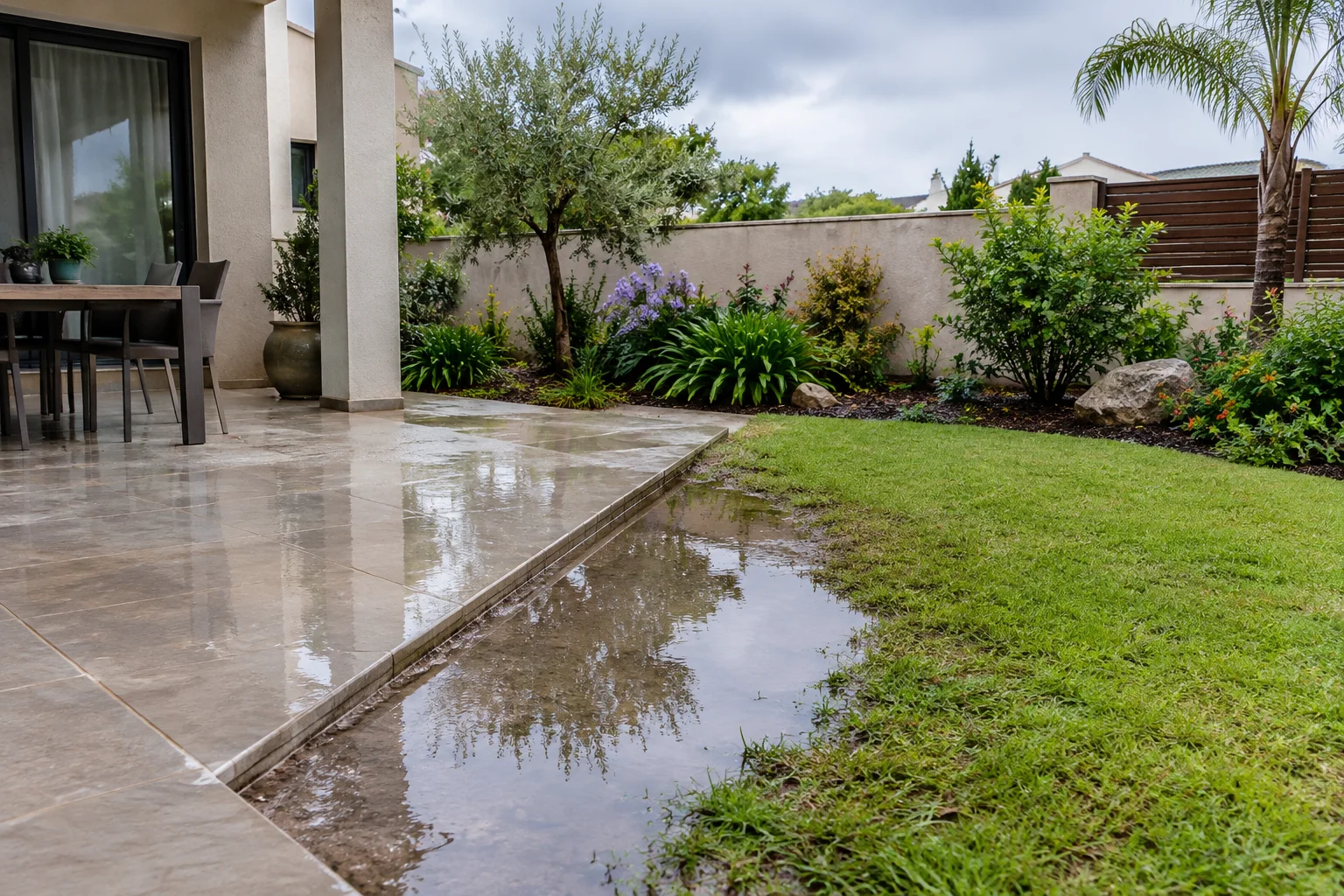
When rain falls, look beyond the deepest puddle. Follow the water uphill or back across nearby paving, paths and planted areas. A puddle is often the final visible point in a longer route.
Take notes while it is raining, if it is safe to do so, or soon afterwards. Record the following:
- Where water first appears and where it gathers.
- Whether it flows from a patio, path, roof downpipe, boundary or higher part of the garden.
- How close it comes to doors, wall openings, outdoor rooms or storage areas.
- Whether it crosses a route you use, such as the path from the house to the gate.
- Whether the water clears quickly, remains for hours, or returns after every substantial shower.
This simple garden runoff assessment does not diagnose the cause. It does, however, show whether the problem is isolated or connected to the wider site. It also prevents a renovation from treating the most obvious symptom while leaving the water route unchanged.
Identify whether the problem is local or connected
A wet planting bed and water collecting near a patio are not necessarily the same problem. First, check whether the issue stays within one small area. Then look for a pattern across connected surfaces.
Water in a planting bed or lawn edge
If water only gathers at the edge of a lawn or within one planting bed, the cause may be local to that area. For example, an edge, compacted ground, or a change in level may be interrupting the route. Even so, avoid assuming that adding more soil or building a raised bed will solve it.
A raised feature can alter where surface water travels. Therefore, it should be planned as part of the whole garden, not treated as a decorative cover for a wet patch. The same applies when replacing natural lawn with synthetic grass. Surface preparation and drainage still matter, regardless of the finish chosen.
Water across patio, paths and garden areas
When several areas hold water, poor garden drainage may relate to the overall arrangement of levels and hard surfaces. A patio can direct water toward a garden bed. Conversely, a garden area may direct water toward the patio or house. Walls, kerbs and edging can also stop water from moving where it needs to go.
In this situation, a wider review is usually more useful than a small patch repair. Read our guide to garden drainage and ground levels for the key relationships to consider before landscaping changes begin.
Check levels around the house and outdoor surfaces
Look carefully at the relationship between ground, paving and the house. You do not need specialist equipment to make useful observations. Stand at a distance and look for visible dips, abrupt steps, uneven joins and places where one surface appears to meet another without a clear route for rainwater.
Pay particular attention to thresholds, patio edges, paths, steps, planter walls and boundary walls. Water collecting near a patio matters because it may affect how comfortably and safely the area works after rain. More importantly, it may indicate that the patio and adjacent garden are not shedding water in a coordinated way.
Do not add soil against an edge, raise a lawn, or lay a new deck simply to hide an awkward level. Those changes can reduce visible puddling in one spot while moving water elsewhere. A deck or paved surface also needs to work with surrounding levels, access and drainage rather than sit above an unresolved problem.
Note the role of roofs, hard surfaces and nearby runoff
Rain does not only fall directly onto the garden. Roof water, paved areas and neighbouring ground may all influence what happens on your property. During your inspection, note the location of downpipes and observe whether water appears to discharge near the affected area.
Also consider hard surfaces. Paving, driveways and paths shed water differently from planted ground. As a result, a modest area of paving can send a noticeable amount of water toward one garden corner during rain. Do not alter, disconnect or dismantle drainage components yourself based on this observation. Instead, document the pattern for an appropriate professional assessment.
If runoff appears to arrive near a shared boundary, simply record the direction and timing. Avoid making assumptions about the source. Levels and drainage routes can be difficult to judge from one rain event, especially on sites with walls, changes in paving or several adjoining gardens.
Why a new surface is not an automatic drainage solution
New paving, synthetic grass, decorative gravel or a raised planter can make an area look tidier. However, none automatically resolves garden drainage problems after rain. Every new surface changes how water meets the ground, edges and adjoining areas.
For example, synthetic grass may suit a practical family area where homeowners want a consistent surface and lower routine lawn care. Yet it still needs considered base preparation and a clear relationship with nearby paving and planting. It is not maintenance-free, and it does not remove the need to understand existing water movement.
Similarly, planting beds can soften a hard garden and help define a renovation. However, filling a low area with soil may redirect runoff toward a path, patio or wall. Before choosing the finish, establish what the water is doing now and what the renovated garden needs to do in future.
Create a simple drainage record before requesting advice
A few useful photos and a rough sketch can make a site visit far more productive. You do not need a measured plan. A clear, honest record is more valuable than a polished drawing.
- Take wide photos from the house, patio and garden corners during or soon after rainfall.
- Take closer photos of puddles, wet edges, downpipes, drains, steps and visible low points.
- On a simple sketch, mark the house, patio, paths, lawn, planting beds, walls and gates.
- Mark where water arrives, which direction it seems to travel and where it remains.
- Add the date and note whether the rain was brief, steady or prolonged.
- List any earlier changes, such as new paving, planters, turf or a modified garden edge.
Photos from more than one rain event are especially useful. Conditions can vary, so a recurring pattern is more informative than one unusual storm. This preparation also helps you explain how the issue affects daily use, whether that means a wet seating area, muddy access, unusable lawn or concern around a threshold.
When a professional site assessment is sensible
A site assessment is sensible before changing paving, turf, planting or levels when water repeatedly gathers near the house, crosses a main path, affects several connected areas, or seems linked to downpipes and hard surfaces. It is also worthwhile when you are already considering a broader garden renovation drainage plan.
During a renovation assessment, the useful question is not only “How do we remove this puddle?” It is also “How should the finished garden direct and accommodate water while supporting the way we use the space?” That wider view helps coordinate patios, paths, lawn areas, planting, planters, shade structures and access.
If several issues overlap, compare the scope of a local improvement with the benefits of a more complete rethink. Our guide to garden renovation versus starting from scratch explains when a focused update may be enough and when connected site problems justify a wider plan.
Put drainage decisions early in the renovation sequence
Drainage decisions belong near the beginning of a garden renovation, before final surfaces and planting go in. First assess the existing site, access, levels and water routes. Next agree the layout and the work needed beneath or around finished areas. Only then should you finalise visible features such as paving, synthetic grass, planting beds, decking or custom planters.
This order avoids undoing new work to correct an overlooked issue. It also lets planting and irrigation planning support the finished layout rather than compete with it. For a broader preparation list, use our garden renovation checklist before work begins.
Creative Garden Co. helps homeowners in Kiryat Gat, Carmei Gat, Even Shmuel and across Southern Israel assess existing gardens before a transformation. If rain regularly leaves your garden difficult to use, bring your photos and sketch to a conversation about a practical renovation plan. The best next step is to understand the whole site before investing in the finish.
For help with your garden project, also see our Garden Renovation & Transformation.