A new planting watering log is a short record of what you see, not a complicated gardening diary. It helps you notice whether plants, soil and irrigation behave differently over time. This is especially useful in Southern Israel. Strong sun, dry periods, reflected heat and shade can vary greatly across one home garden.
New planting needs closer attention than established planting because its roots are still growing into the surrounding soil. However, a drooping leaf or dry-looking patch does not automatically mean the garden needs more water. By recording conditions before making assumptions, you create useful information. You can then share it with an installer or maintenance professional who reviews the bed.
Why new planting deserves a separate record
A mature bed and a newly planted bed need different checks. Established plants have had time to grow roots beyond their original planting area. By contrast, new plants are still adapting to their position, soil, sun exposure and irrigation arrangement.
Therefore, the early period after planting is the right time to observe patterns. For example, one side of a bed may receive more afternoon sun. A plant beside paving may face extra reflected heat. Meanwhile, one near a wall may receive less direct light or less rainfall. These differences can affect how the same planting appears across the bed.
The record does not replace professional assessment or an agreed irrigation handover. Instead, it gives that conversation a clearer starting point. Before you begin, make sure you understand the zones, access points and care responsibilities in your new garden handover checklist.
Set up a new planting watering log
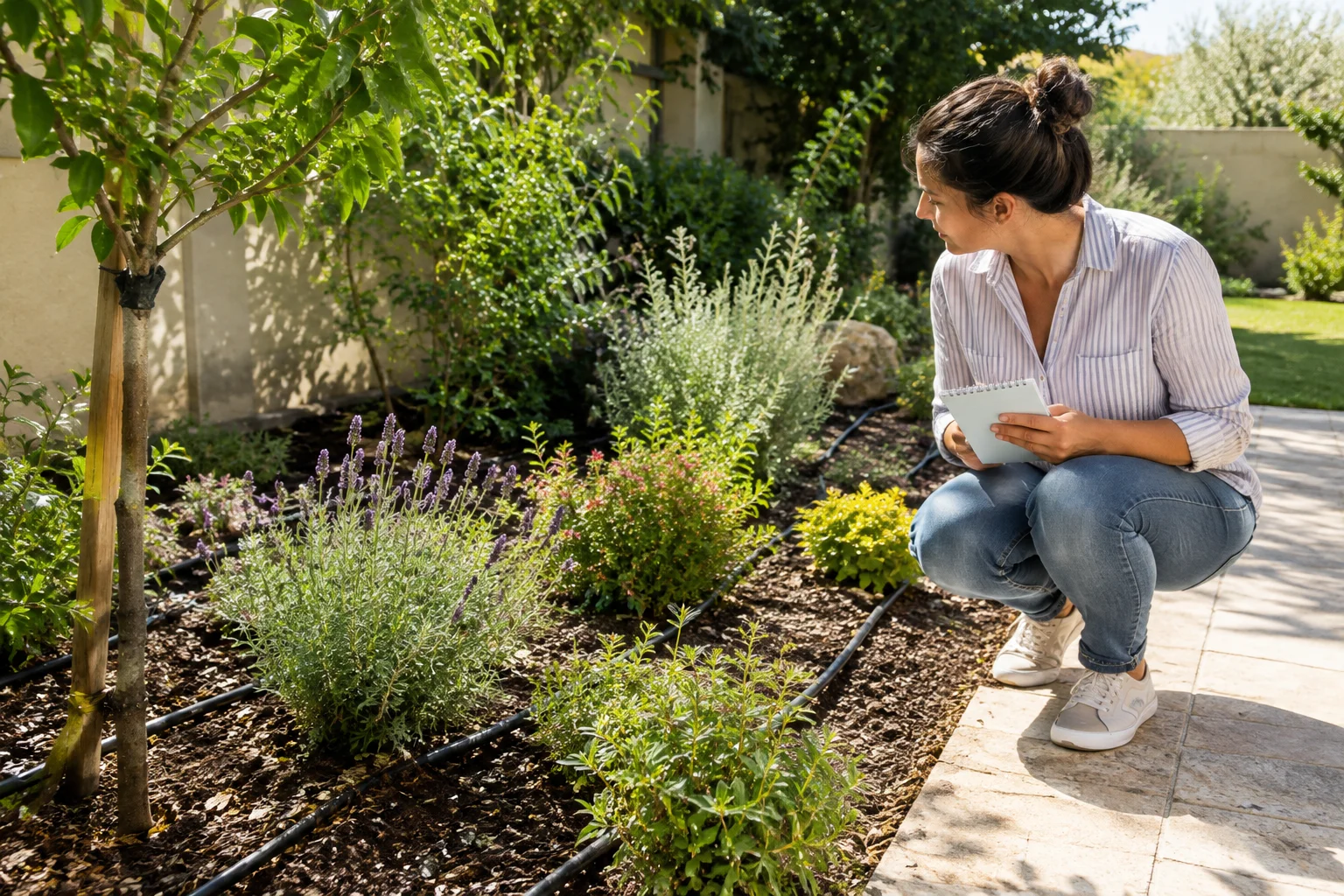
Keep the format simple enough that you will use it. For instance, use a phone note, spreadsheet or small notebook. Aim to make an entry after a meaningful weather change, rainfall, or a repeated difference in the bed.
You do not need to record every day forever. At first, regular brief checks help you learn the garden. Later, you can check less often once the bed seems settled. However, return to regular notes if an issue needs attention.
Use these headings for each entry
- Date and time: Record when you looked, especially when comparing several observations.
- Weather observed: Note conditions such as hot, windy, overcast, dry, or rain since the last check. Record what you observed instead of relying on a general forecast.
- Sun and shade: Write which parts of the bed had direct sun, shade or strong reflected heat at that time.
- Water received: Note whether irrigation ran as expected or rainfall occurred. Avoid recording a guessed watering quantity.
- Soil surface and moisture observation: Describe what you can see and feel at the surface without digging around roots. For example, write “surface dry beneath mulch, no pooling” or “soil looks dark and damp near the edge”.
- Plant appearance: Note changes such as upright, limp, pale, scorched-looking, damaged, flowering or new growth. Also, describe the plant or its location clearly.
- Location: Identify the exact section, such as “left side beside patio” or “rear shaded corner”.
- Action or follow-up: Record any change made by the installer or maintenance professional. Then add the date for a review.
A useful entry might read: “12 June, late afternoon. Dry and very sunny. Front edge beside paving had direct sun; rear corner shaded. Irrigation occurred. Surface looked dry at front edge; no pooling. Two plants at front edge looked less upright than the rest. Photograph taken from patio.” This records facts without deciding the cause too soon.
Observe soil and plants without jumping to conclusions
The purpose of a new planting watering log is to separate observation from diagnosis. Plants can look different at different times of day. In addition, heat, wind, transplant adjustment, drainage, root condition, shade or irrigation distribution may affect their appearance. It is not always a simple lack-of-water issue.
Start with visible clues. For example, look for an area that repeatedly dries faster than another. Also note a plant group that consistently looks different from nearby planting. Watch for water that pools, runs across the surface or remains visible long after irrigation or rain. These details are more useful than a one-off comment that a plant “looks unhappy”.
Do not repeatedly disturb new plants to inspect roots or alter irrigation equipment yourself. Similarly, avoid frequent, unrecorded changes if you want to know what helped. If a professional adjusts the system or reviews the planting, write down what changed. Then continue observing the same areas.
Pay attention to small site differences
In a Carmei Gat, Kiryat Gat or Even Shmuel garden, one bed can contain several micro-conditions. For instance, a boundary wall can change shade and airflow. Paving can increase heat around an exposed edge. Likewise, a pergola may create a sheltered strip. A corner near a downpipe or slope may behave differently during the rainy period.
For that reason, divide a longer bed into simple sections instead of giving the whole bed one description. Label them on a rough sketch: front edge, centre, wall side and shaded corner. This makes it easier to see whether a concern belongs to one location. It also shows whether the concern affects the entire bed.
The same principle supports good irrigation planning. Plants with different conditions or needs may need different consideration. Therefore, avoid a single blanket approach where possible. Our guide to planning garden irrigation zones in Southern Israel explains why beds, trees, lawn and planters should be considered as separate areas where appropriate.
Take comparable photographs over time
Photographs often reveal change more clearly than memory. Take them from the same position and, where possible, at a similar time of day. Also include a fixed reference point, such as a path edge, planter or wall. A wide image shows how the bed works as a whole. Meanwhile, a closer image can document a particular plant or dry patch.
For example, choose one viewpoint from the patio and one from the path. Repeat those two images every week or after a notable change. Save each image with the date and location. Then a professional can compare the pattern rather than rely on one image from a difficult day.
Photos should support the written new planting watering log, not replace it. A picture may show leaves hanging lower. However, the note explains whether this followed several hot days, rain, or full exposure in one part of the bed.
Record professional changes, not controller instructions
An irrigation handover should make clear who will deal with adjustments during the establishment period. If the installer or maintenance professional changes a zone, checks a drip line, improves coverage or reviews drainage, record the date. Also note the affected bed section and the reason given. Then keep observing the result.
For instance, you could write: “Maintenance visit: front planting edge reviewed. Irrigation checked by professional. Continue photographs and observe whether uneven appearance repeats.” This preserves the sequence of information. It also avoids turning the log into a controller-programming guide.
Water-conscious care depends on matching irrigation to conditions and plant needs. In other words, it does not rely on one fixed schedule everywhere. The Israeli guidance from Central Arava Water also advises grouping plants by their needs and adapting irrigation accordingly. Conditions in the Arava do not set a watering schedule for Kiryat Gat. Still, the principle is useful: record your own garden conditions before requesting a change.
When the log should prompt a garden review
One unusual observation is not necessarily a problem. Repeated patterns, however, deserve attention. A clear record lets you report what happens, where it happens and whether it follows particular conditions.
- One section of the bed repeatedly performs differently from comparable nearby planting.
- The same patch repeatedly appears dry while other parts of the bed do not.
- Water pools, runs off or collects in one area after irrigation or rain.
- Several plants decline in the same location over repeated observations.
- Visible irrigation issues, such as water appearing where it should not, coincide with a change in plant performance.
- A professional adjustment has not improved the repeated pattern after a reasonable observation period.
At that point, share your notes, photographs and rough bed sketch rather than attempting a repair. The issue may require a review of irrigation distribution, drainage, planting position, shade or another site condition. You can also use our guidance on reducing irrigation water waste to understand why early observations of pooling and uneven performance matter.
A practical routine that stays manageable
Keep the routine brief. First, walk the newly planted bed and view the whole planting from a distance. Then inspect the exposed and shaded edges. Note anything that repeats, photograph the same viewpoints and add a few lines to the log. This usually takes only a few minutes.
Most importantly, record what you can see instead of trying to solve every change yourself. A simple new planting watering log creates a useful establishment history. As a result, it can help you make calmer decisions, avoid unnecessary changes and give a garden professional context for a targeted review.
If your new garden or renovated planting beds show recurring uneven performance, Creative Garden Co. can assess the wider picture. We can review planting, irrigation and the conditions around the bed. Then we can help you decide on a sensible next step for your Southern Israel home.
For help with your garden project, also see our Garden Irrigation System Installation That Lasts.