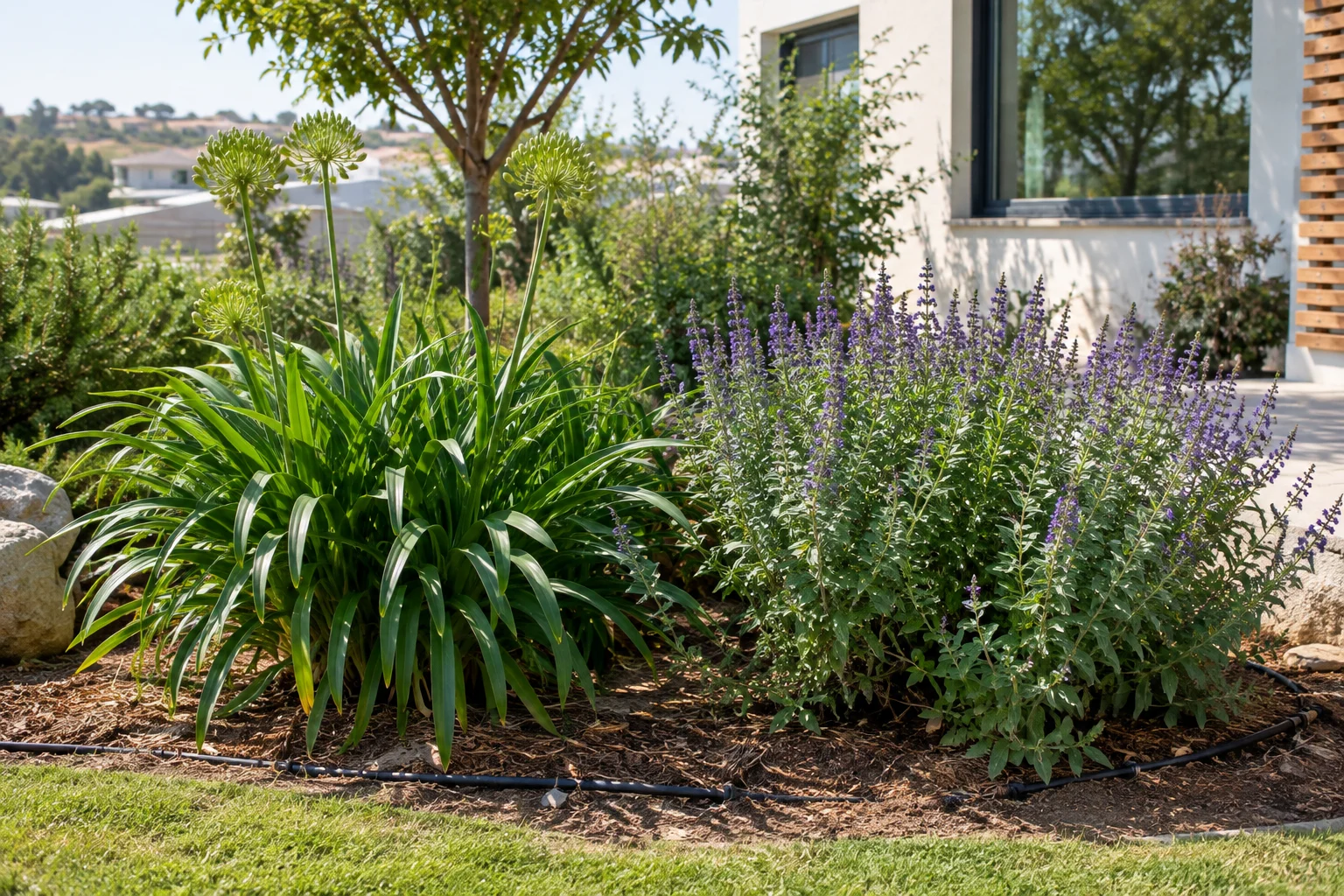
An Agapanthus and Salvia comparison helps because both profiles allow sun or partial shade. However, that shared guidance does not make the plants interchangeable. Before planting, compare the verified details. Then assess conditions in your own Southern Israel garden.
This comparison considers Agapanthus africanus and Salvia greggii Furmans Red. The supplied Israeli profiles list both for sun or partial shade in most regions. However, the Salvia profile also calls for well-drained soil. Meanwhile, the Agapanthus profile identifies a rhizomatous perennial. These details raise different planting questions.
Agapanthus and Salvia comparison: the verified profile points
First, separate the stated profile details from assumptions. The profiles do not offer complete planting specifications. Instead, they provide a useful first filter when assessing a site.
- Agapanthus africanus: a rhizomatous perennial for sun or partial shade in most regions of Israel.
- Salvia greggii Furmans Red: for sun or partial shade and well-drained soil in most regions of Israel.
Israeli plant profiles provide these descriptions for gardening in Israel. You can review the relevant plant profile source for the stated guidance. Still, “most regions” does not guarantee success at every home in Kiryat Gat, Carmei Gat or Even Shmuel. Check exposure, soil condition, drainage and irrigation at your site.
Shared sun or partial-shade guidance is only a starting point
Both plants share the same verified light description: sun or partial shade. Therefore, either may suit a bed with substantial daylight. However, the phrase does not predict every response to heat, reflected light, wind, soil or irrigation.
For example, a bed beside a hot paved patio may behave differently from one near a shaded wall. Likewise, one part of a garden may dry faster than another. Record the actual light pattern before choosing plants. Do not treat a broad light label as a finished design decision.
This check matters in Southern Israel. Strong sun and long dry periods can affect bed performance. In addition, consider which areas share irrigation. Our guide to planning garden irrigation zones in Southern Israel explains why plants need compatible watering arrangements, not just a pleasing appearance.
What the rhizomatous description tells you about Agapanthus
The verified Agapanthus profile identifies Agapanthus africanus as a rhizomatous perennial. That description helps botanically. However, it does not confirm mature dimensions, clump character, spread or planting distance.
Therefore, do not select spacing from the rhizomatous label alone. A nursery plant may appear compact at purchase. Yet the supplied profile does not confirm the space it will need later. Ask the supplier for its expected mature size. Then consider paths, edging, nearby plants and future care access.
In a narrow border, the missing dimension matters. A plant may suit the light but still crowd a path or seating area. It may also conflict with another perennial. Consequently, review the planting layout as part of the whole garden. Avoid treating each plant as an isolated purchase.
Why the Salvia drainage note matters
The Salvia greggii Furmans Red profile specifically calls for well-drained soil. Consequently, make drainage a direct part of the decision. Watch how the proposed bed behaves after irrigation and during rainy periods. Note whether water lingers in any area.
Importantly, the Salvia note does not show that Agapanthus africanus tolerates poor drainage. The supplied profiles do not make that claim. Therefore, do not use one plant’s requirement to fill a gap in the other profile.
If drainage remains unclear, observe the bed before planting. This step is especially useful in a new garden. It also helps after level changes or where paving directs water into a border. A local assessment can show whether you need another plant choice or further site attention.
Details this flowering perennial comparison does not verify
A careful comparison prevents overconfident choices. The available profile snapshots do not verify the following details for either named plant:
- Mature height, width, spread or spacing.
- Flower colour or flowering dates.
- Toxicity or suitability around children and pets.
- Root behaviour or safety near paving and structures.
- Watering quantities, run times or fixed irrigation intervals.
- Pest control, pruning timing or universal long-term care instructions.
These questions still matter. However, you need reliable plant-specific information before using them for a final purchase or layout. In particular, confirm relevant details before choosing either plant for a precise seasonal display. Do the same for confined spaces or pet-accessible areas. Consult an appropriate source or plant professional.
Plan establishment separately from established care
New planting needs observation while it establishes. Established plants may need a different approach later. The supplied Israeli guidance distinguishes establishment irrigation from established low-water perennial needs. Therefore, do not assume a permanent watering routine on planting day.
Rather than follow a universal quantity or interval, observe the soil and plants. Then adapt irrigation to weather and plant needs. Grouping plants by need also supports more considered watering. Where appropriate, mulch can limit soil drying, heating and weed growth.
For broader context, read our guide to low-water plant planning for Southern Israel gardens. It explains why plant selection, bed design and watering zones should work together. However, it does not replace the unanswered details in these two profiles.
Choosing between Agapanthus and Salvia for your garden
Neither plant is the automatic winner. Both have verified sun or partial-shade guidance. However, Salvia greggii Furmans Red has an explicit well-drained-soil requirement. Meanwhile, Agapanthus africanus has a verified rhizomatous perennial description. The supplied information does not confirm its mature footprint or spacing.
Before choosing, identify the exact planting position. Next, observe light throughout the day and check how the bed drains. Also decide which irrigation zone will serve the area. Then confirm the plant-specific details that matter for your household and layout. This approach offers a stronger basis than a name, photograph or broad category.
If you are planning a new border or revising an established garden, Creative Garden Co. can assess planting positions with soil, irrigation and the wider layout. Explore our garden design and installation service to plan planting as part of a practical, long-term garden.