Why trees lose leaves in winter comes down to a seasonal survival strategy, not necessarily a problem. Deciduous trees shed most of their leaves over a relatively short period. In contrast, evergreen trees also lose leaves, but they replace them gradually and usually remain leafy throughout the year.
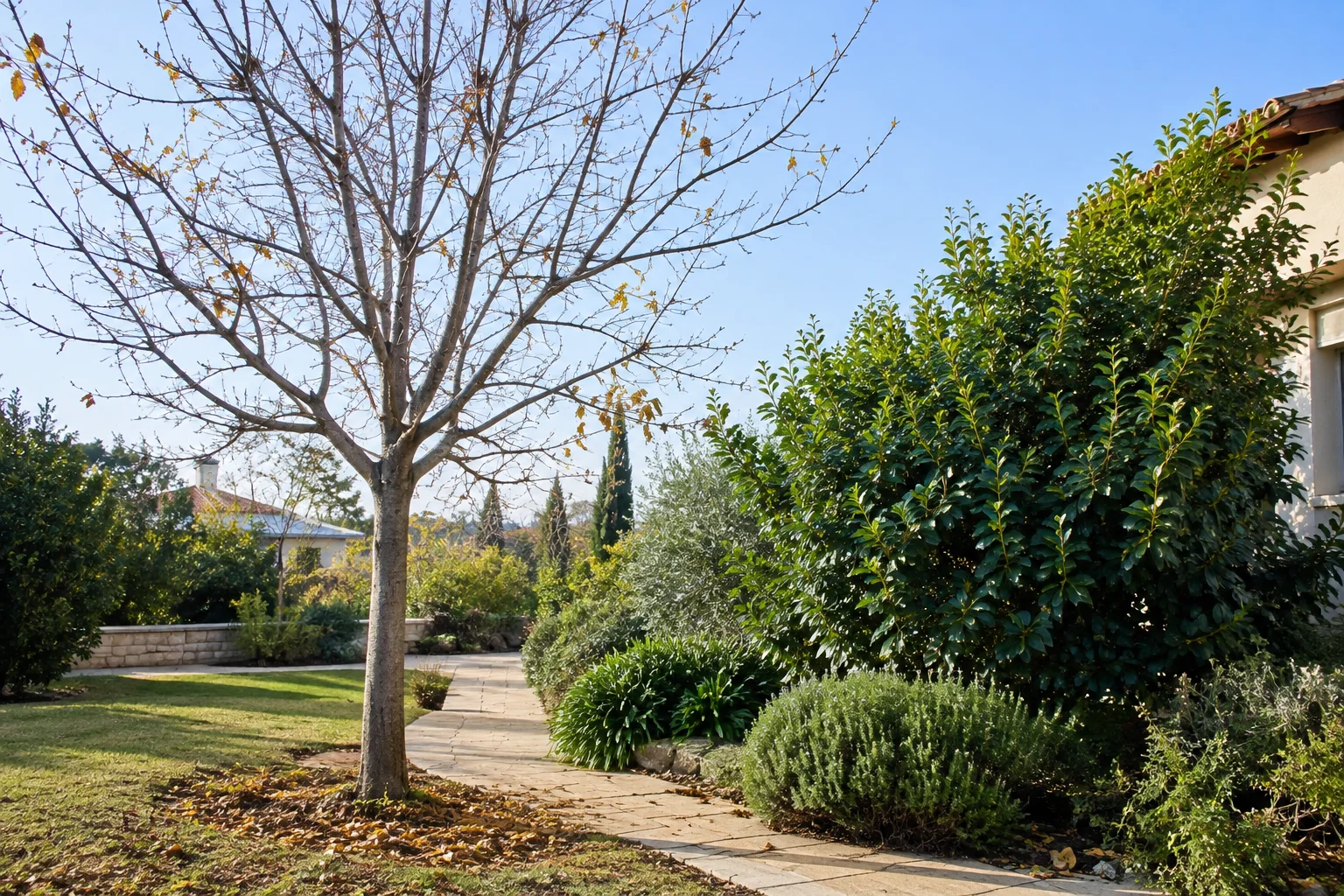
For homeowners in Southern Israel, a suddenly bare tree can look alarming beside green shrubs. However, leaf shedding often reflects the tree’s natural cycle. The important question is whether the tree is deciduous and whether the change matches its usual seasonal pattern.
Deciduous trees shed leaves in a concentrated season
A deciduous tree drops much of its foliage in one concentrated period. As a result, its branches may stand bare during the cooler part of the year. This differs from an evergreen tree, which continually renews individual leaves while keeping an overall green canopy.
That distinction explains why trees lose leaves in winter so visibly. An evergreen does not necessarily keep every leaf forever. Instead, it replaces older leaves over time, so leaf loss is less obvious. A deciduous tree makes that renewal a far more noticeable seasonal event.
Therefore, bare branches alone do not prove that a garden tree has died. They may simply show that the tree is deciduous and entering its quieter seasonal phase. An Israeli landscape guide from Papirus Gan explains the difference between concentrated deciduous leaf shedding and gradual evergreen renewal.
Why trees lose leaves in winter at different times
Trees do not use a calendar. Instead, they respond to changing environmental signals. Shorter daylight and cooler conditions can influence the seasonal response. However, the exact timing varies because each plant has its own inherited characteristics.
This is why trees lose leaves in winter at different times, even within the same neighbourhood. One tree may begin shedding before another, while a different species may remain leafy for longer. Temperature, site conditions and the tree’s own biology can all affect the visible change.
Southern Israel gardens can have very different exposures and growing conditions. During the cooler part of the year, shorter days and changing temperatures may matter as much as the weather on one particular day. Consequently, homeowners should avoid comparing every tree directly with a neighbour’s different species.
Not every deciduous tree follows the same timetable
Deciduous trees can shed their leaves over different periods. A plant’s response reflects both its inherited traits and its environment.
For that reason, knowing the tree’s name helps before deciding that seasonal leaf loss is unusual. Likewise, a photograph taken at the same time each year can help you recognise its normal pattern without relying on memory.
What happens inside a tree after leaf shedding?
Leaf loss does not mean that the whole tree has stopped functioning. Before a deciduous tree sheds its foliage, it relocates materials into its stems and roots. These stored reserves support later growth when conditions become favourable again.
At the same time, the tree enters a period of reduced metabolic activity, often called dormancy. Put simply, much of the visible activity above ground becomes quieter. This helps explain why trees lose leaves in winter without being dead or permanently inactive.
Still, it is important not to overstate dormancy. Reduced activity does not mean every root has stopped growing. Different species also do not follow identical patterns. Root behaviour depends on the plant and site conditions. Therefore, a bare canopy cannot diagnose what is happening below ground.
What leaf shedding means for garden care
When a deciduous tree drops leaves, clear fallen foliage from paths, patios and drains where it affects the garden’s appearance or day-to-day use. In planting beds, decide case by case whether leaves suit the garden’s appearance and maintenance needs. However, a tidy garden does not require stripping every natural sign of the season from every bed.
Meanwhile, do not treat a bare tree as an automatic reason to cut it back. If pruning is being considered, ask for a professional assessment of the particular tree and its place in the garden.
It is also sensible to keep watching the tree rather than making a quick diagnosis. For example, note whether buds develop as conditions become favourable again. Also check whether branches remain sound and whether the same cycle occurs each year. If you see damaged branches, unusual dieback or an unfamiliar pattern, arrange a professional assessment.
Choosing between deciduous and evergreen trees
Understanding why trees lose leaves in winter can help when planning a garden. A deciduous tree may offer changing seasonal character and allow more winter light into an outdoor seating area. However, it also brings a concentrated leaf-clearance task and less screening during its bare period.
An evergreen tree may suit a location that needs year-round structure or privacy. On the other hand, evergreen foliage still needs routine attention and may cast shade throughout the year. Neither choice is universally better. Instead, the best option depends on the garden’s purpose, available space, sun, irrigation and the homeowner’s maintenance preferences.
For a tree near a pergola, patio or main seating area, consider its mature form and seasonal effect before planting. A tree that provides welcome summer shade may also change how that space feels during the cooler season. Therefore, planning for that cycle creates a more comfortable outdoor area in every season.
When to ask for maintenance help
Seasonal leaf loss is normal for many deciduous trees, but gardens still benefit from informed care. Professional garden maintenance can help homeowners assess trees, clear seasonal buildup and keep planting areas practical. In this way, you can avoid assuming that every bare branch signals a fault.
If your garden in Kiryat Gat, Carmei Gat, Even Shmuel or the surrounding area has trees that look unhealthy, overcrowded or difficult to manage, Creative Garden Co. can help. Together, you can review the garden’s condition and plan appropriate ongoing care.